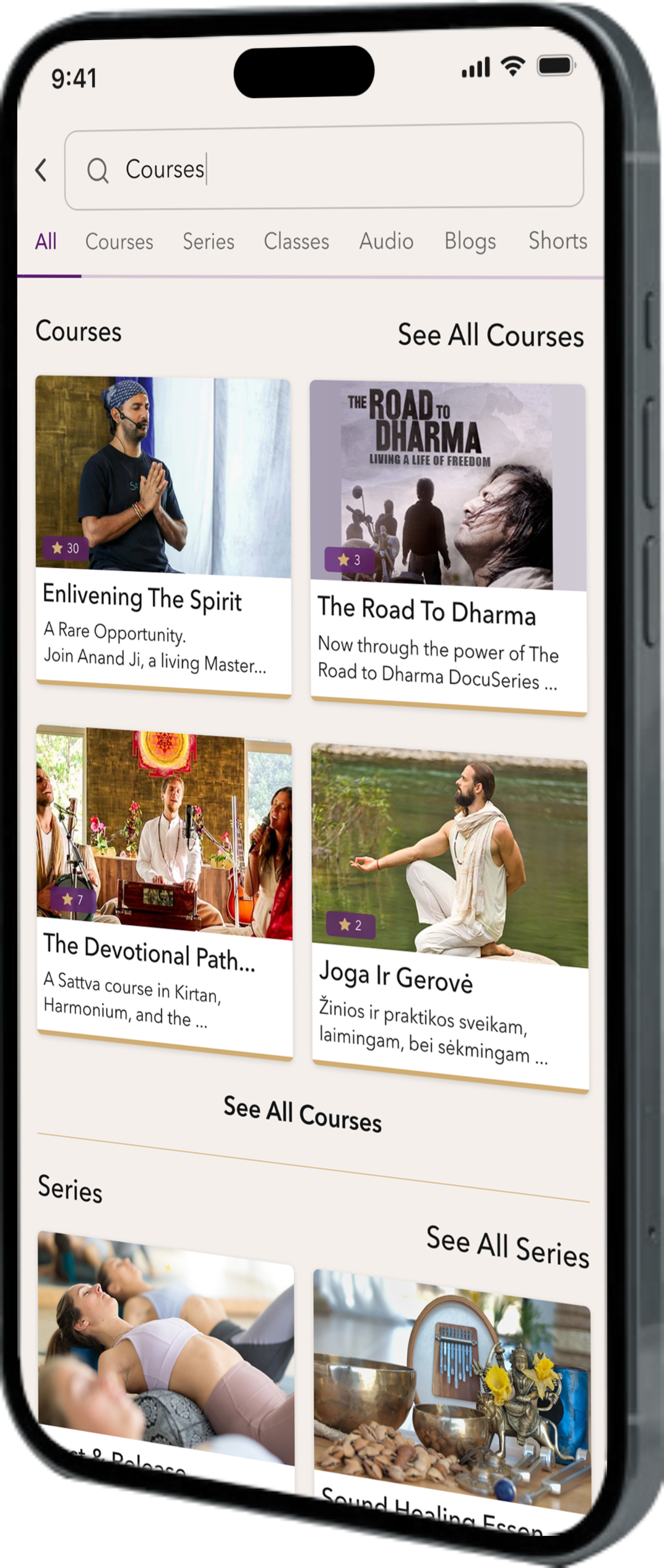

Get the Sattva app for
App exclusive features
Including member-only experiences

by Sattva Connect

Practising yoga online can mean many different things.
You might join a live class, choose an on-demand session when you have time, or follow a structured course designed to develop a particular area of practice over several lessons.
That difference matters.
Yoga courses online are most valuable when they provide more than individual classes. A good course creates progression. It helps you understand why you are practising something, how one lesson connects to the next, and how your knowledge can deepen over time.
At Himalayan Practices, online learning is rooted in Rishikesh, India, and brings together asana, meditation, pranayama, philosophy and deeper yogic practices for a global community.
An individual yoga class is often designed to stand on its own.
You may join a Hatha session, a Vinyasa practice or a guided meditation without needing to complete anything before or after it.
A course is different.
It usually follows a sequence.
Each lesson builds on previous material, allowing practitioners to develop a skill, understand a topic or explore a practice with greater depth.
For example, a beginner course might begin with foundational postures and breath awareness before moving toward stronger standing sequences and simple pranayama.
A philosophy course may introduce basic concepts before exploring individual texts or traditions in more detail.
A pranayama course should develop breath practices progressively rather than presenting advanced techniques without preparation.
This structure is what gives a course its value.
One of the difficulties of practising entirely through random classes is knowing what to do next.
A course provides direction.
Instead of continually choosing sessions based only on mood or duration, you can follow a pathway designed to build knowledge or ability gradually.
A course can create space to explain things that may be difficult to cover in a standard class.
That might include:
This can make the practice more meaningful and less mechanical.
Having a clear sequence of lessons can remove some of the daily decision-making around practice.
You know what comes next.
For many people, that makes it easier to maintain momentum.
Yoga courses can also make it easier to explore dimensions of yoga that do not fit naturally into a single physical class.
Meditation, pranayama, philosophy and deeper study often benefit from continuity and repetition.
The right course depends on what you want to explore.
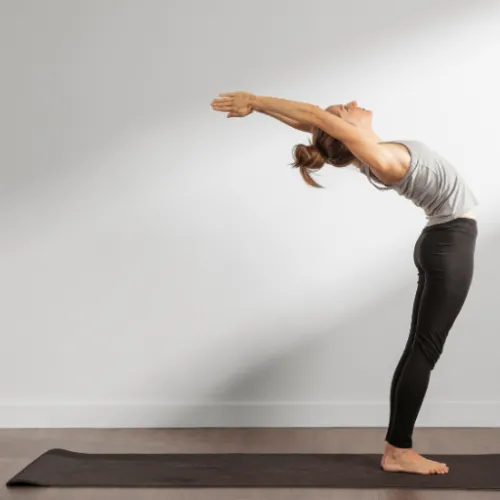
A structured asana course can help practitioners develop a stronger physical foundation.
Rather than practising disconnected sequences, students can work progressively with:
The focus should not simply be on reaching more advanced poses.
Good progression develops greater control and understanding.
Hatha courses may provide more time to study individual postures, alignment principles, breath and stability.
This can work well for beginners as well as experienced practitioners looking to refine their foundations.
A Vinyasa course can help practitioners understand how movement, breath and sequencing relate to one another.
Progressive learning is particularly useful here because it allows strength, coordination and familiarity with transitions to develop gradually.
Pranayama refers to traditional yogic practices involving conscious regulation and awareness of the breath.
Because these techniques range from simple to more advanced, they are especially well suited to structured learning.
A thoughtful course should introduce practices gradually and explain when modifications or caution may be appropriate.
Meditation courses can help practitioners move beyond simply “trying to sit quietly.”
A progressive approach may explore breath awareness, concentration, observation, stillness and different ways of working with attention.
Yoga philosophy provides context for the wider tradition.
A structured course can make philosophical ideas more accessible by introducing them step by step rather than assuming prior knowledge of Sanskrit terms or traditional texts.
More experienced practitioners may also explore kriya or other deeper yogic practices.
These should be taught with appropriate context, progression and guidance rather than presented as quick techniques or isolated experiences.
Online courses can serve practitioners at different stages.
They may be useful for:
The important point is choosing the right level.
A course should clearly explain who it is designed for and whether previous experience is required.
Beginners often benefit especially from structured learning.
When you are new to yoga, it can be difficult to know:
A beginner course can answer these questions gradually.
Instead of being exposed to a large library and having to decide where to begin, you are given a clear starting point.
This can make learning feel more manageable and less intimidating.
Do you want to:
A clear goal makes choosing much easier.
“Yoga course” can mean anything from absolute beginner foundations to advanced study.
Make sure the stated level matches your experience.
Consider the teacher's experience, training and area of expertise.
A strong course should be taught by someone with substantial understanding of the subject rather than simply familiarity with online presentation.
Look for a clear sequence.
You should be able to understand what the course covers and how the lessons progress.
A large number of videos does not necessarily create a good course.
The material should connect.
Each lesson should have a reason for being there.
Recorded courses are convenient, but opportunities to ask questions or attend live sessions can add significant value, particularly for more technical subjects.
These terms should not be used interchangeably.
Classes are ideal for ongoing practice.
They may be live or on demand and can be selected individually according to your schedule, level or preferred style.
Courses provide a more structured learning pathway around a specific subject or goal.
They are useful when you want progression rather than simply variety.
Teacher training is professional or pre-professional education designed for people preparing to teach or wanting a much deeper level of study.
It usually includes areas such as teaching methodology, anatomy, practicum, philosophy and assessment.
If your objective is to become a yoga teacher, look for a dedicated teacher-training programme rather than assuming any online yoga course provides a teaching qualification.
Himalayan Practices was born in Rishikesh, India, and brings structured yoga learning into an online environment designed for an international audience.
The wider platform allows practitioners to explore areas such as:
This creates different entry points.
A beginner can start with foundational yoga.
A physically experienced practitioner may focus on stronger asana.
Someone interested in meditation or breathwork can follow a different pathway.
The aim is not to push every practitioner toward the same outcome.
It is to provide enough structure and depth for practice to develop over time.
If the course has been designed progressively, avoid jumping ahead simply because a later lesson looks more exciting.
Foundations matter.
You do not need to treat every lesson as something that must be completed once and left behind.
Repetition is part of learning.
A course is only useful if you can stay engaged with it.
Choose a pace that works with your actual life.
Learning becomes more meaningful when ideas are applied.
If you learn a breathing practice, return to it.
If a posture sequence reveals an area that needs work, revisit it.
Progress in yoga is not always measured by achieving a more difficult posture.
Sometimes progress means understanding a familiar practice more clearly.
An online class is usually a standalone practice session. A course follows a structured sequence of lessons designed to help you build knowledge or ability progressively around a specific topic or goal.
Yes. Beginner courses can provide a clear learning pathway through foundational postures, breathing and introductory meditation without requiring previous experience.
Depending on the programme, you may study asana, Hatha yoga, Vinyasa, pranayama, meditation, Yoga Nidra, philosophy or other aspects of yoga.
This depends on the programme. Some courses are fully self-paced, while others may include live sessions, cohort schedules or time-limited access. Check the course format before enrolling.
Not necessarily. General yoga courses and yoga teacher training are different. If you want a professional teaching qualification, choose a dedicated teacher-training programme and verify exactly what certification or credential it provides.
Online access has made yoga easier to reach.
But access alone is not the same as learning.
The value of a structured yoga course is that it gives practice direction.
Instead of moving randomly between sessions, you can develop understanding over time—whether you are working with asana, meditation, pranayama or philosophy.
Himalayan Practices brings these different dimensions of yoga together through learning rooted in Rishikesh and created for practitioners around the world.
For anyone looking for more than an occasional class, a well-designed course can offer the structure needed to move from simply practising yoga to understanding it more deeply.























































Monday 26 Oct 2026 07:00:00 PM IST
Tuesday 27 Oct 2026 07:00:00 PM IST
Wednesday 28 Oct 2026 07:00:00 PM IST

Thursday 29 Oct 2026 07:00:00 PM IST
Monday 26 Oct 2026 06:00:00 AM IST
Friday 30 Oct 2026 06:00:00 AM IST

Your purpose here is to evolve, to transform, to experience your radical aliveness, to awaken to your true nature. You are the path. The path is you. The time is now.